Choosing a home blood pressure monitor
Validation, cuff fit and format decide whether a monitor is worth owning — not the box, and not the brand name on it.
Validation is the first filter
Two monitors can look almost identical on a shelf and behave very differently in use. The deciding factors are validation status, cuff fit, and whether the format suits your arm and your routine. This page works through those in order, with the UK brands and validation lists you will actually encounter.
Publishes the list of home monitors that have passed its validation protocol. The list is the practical starting point for any UK purchase.
Model-by-modelA second independent list, useful when a model you are considering is missing from the first. Checking both takes a few minutes.
Cross-checkA brand may sell six monitors and have validated two of them. Validation applies to individual devices, not to a company's whole catalogue.
Check the modelNot automatically useless. It does mean you are taking accuracy on trust rather than on an independent test, which is a different kind of decision.
On trustConfirm the model on a list, then check the cuff range covers your arm, then decide whether the format fits how you actually measure.
Validated first
Upper-arm or wrist: what the difference costs you
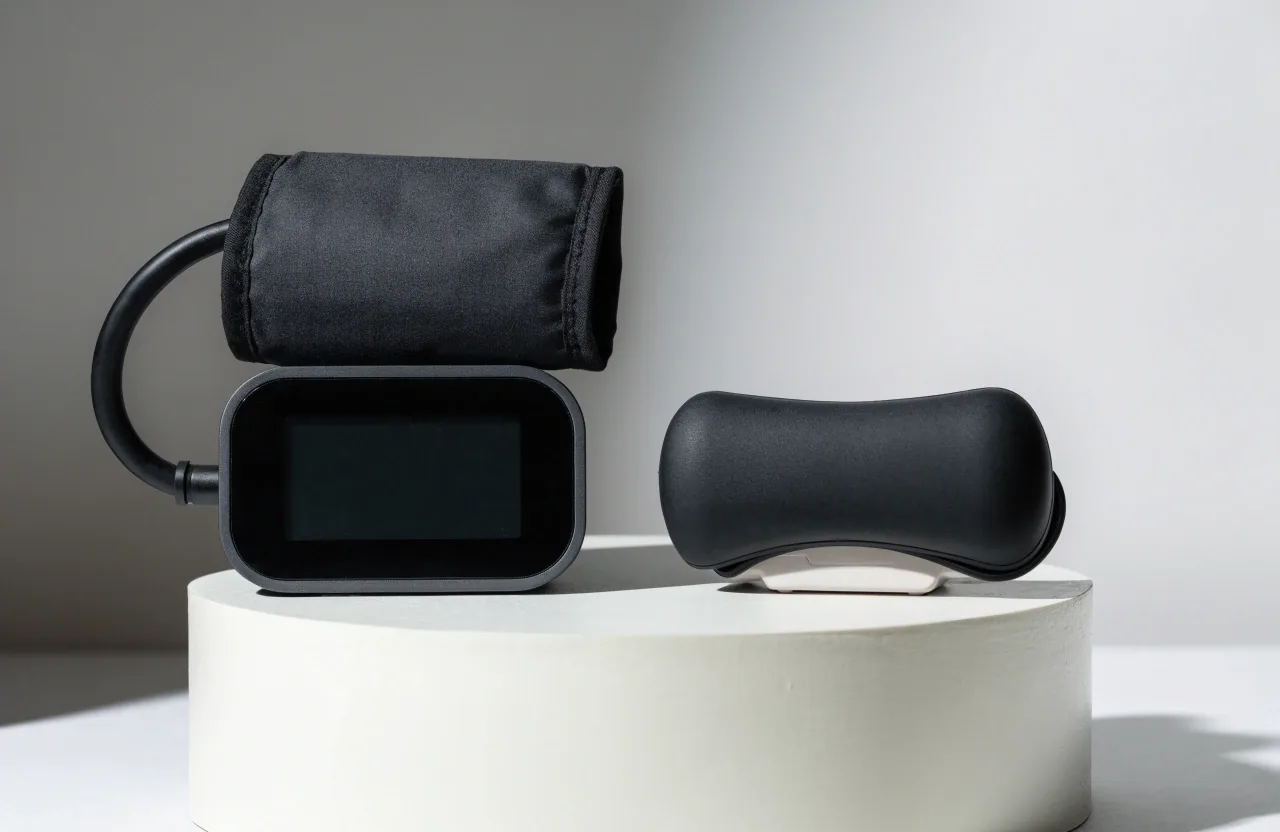
Upper-arm monitors are the usual recommendation. Cuff fit is more forgiving, the measuring position is easier to hold, and most clinical validation work has been done on this format. If you are buying your first monitor and have no specific reason to choose otherwise, this is the sensible default.
Wrist monitors are smaller and easier to store, which matters if you travel or have limited space. The trade-off is position: the wrist must be held at heart level throughout the measurement, and small deviations change the result. They suit some people well and frustrate others, and the deciding factor is usually how steadily you can hold the position.
- Upper arm: forgiving cuff fit, steady position, the validated format
- Wrist: smaller, easier to store, position-sensitive every time
Cuff size is the detail people skip
A cuff that is too small will read high. A cuff that is too large can read low. Neither is a device fault, and neither is obvious from the reading itself.
Measure your upper arm circumference at the midpoint between shoulder and elbow before you buy, then match it to the cuff range printed on the box. Many monitors ship with a standard cuff covering a mid-range circumference. If your arm falls outside that range, you will need a different cuff, and it is worth confirming availability before committing to a model. This is one of the most common reasons home readings do not match clinic readings.
Reads higher than your true pressure. The number looks plausible, so nothing warns you that the fit is wrong.
Can read lower. Again, the reading itself gives no clue that the cuff is the cause.
Upper arm circumference, midpoint between shoulder and elbow. One tape measure, done once, before you order.
If your arm falls outside the supplied cuff range, confirm a larger or smaller cuff exists for that model before you commit.
Mismatched cuff size is one of the most common reasons home readings do not match the ones taken in clinic.
Brands you will see in UK shops and charities
Three names come up again and again in UK listings, charity ranges and consumer roundups. They are described here by what they are known for, not as a ranking — the validation list still decides for the specific model you are buying.
OMRON
The name most people meet first. It is a major brand in the UK market, the British Heart Foundation describes it as the global number one brand in digital blood pressure monitors, and its UK range includes clinically validated upper-arm and wireless models. Current models highlight Intelli Wrap cuff technology, which is aimed at reducing errors from cuff placement.
Kinetik Wellbeing
Appears in the British Heart Foundation's current monitor range and in UK wrist monitor listings, positioned as a mainstream at-home option.
A&D Medical UA-767F
An upper-arm monitor that shows up in consumer testing roundups, typically praised for doing a straightforward job without extra complexity.
Shared in validation terms
All three are commonly discussed alongside each other when people compare what has been independently validated.
The sports-tech crossover
The Garmin Index BPM is a smart blood pressure monitor that appears in UK product testing coverage. It is notable mainly because Garmin is better known for wearables than clinical monitors, and because it links into a wider health ecosystem rather than standing alone.
Whether that matters depends on what you want. If you already use connected health tools and want readings to sit alongside them, the integration has obvious appeal. If you want a single-purpose device with a straightforward cuff and a clear display, the appeal is less obvious. Either way, check validation status before deciding.
Where to buy in the UK
Buying through a charity or pharmacy does not change the device, but it does give you a route to advice if something seems wrong. That is worth something, particularly for a first purchase.
LloydsPharmacy runs a dedicated blood pressure monitor category online, with brands including Omron, Kinetik and Braun.
The British Heart Foundation sells monitors through its shop and educational pages, and states that the devices it stocks are vetted by its expert team and approved by BIHS or STRIDE BP for accuracy.
General retailers and online marketplaces are also options, though you will usually be checking validation status yourself.
Features worth paying for, and features that are not
What is not worth paying extra for is a brand name alone, or a feature list that does not include validation for that specific model. Everything else sits somewhere between useful and optional, and which is which depends on how you will use the monitor.
Memory storage. A monitor that keeps the last several readings lets you review a pattern without relying on handwritten notes.
Irregular heartbeat detection. Appears on many mid-range models and is a flag to mention to a clinician, not a diagnosis in itself.
Backlit display. Helps in low light, which matters if you measure early in the morning or late at night.
Bluetooth and app sync. Convenient if you already track health data, and largely irrelevant if you do not.
A brand name on its own. Paying more for the logo, without a validated model behind it, buys you nothing you can rely on.
Matching the monitor to your routine
Think about when you will actually measure. If it is first thing in the morning, a monitor that takes thirty seconds and stores the result will get used. If it requires a phone, an app, and a sync, it may not. The best monitor for you is the validated one you will use consistently.
Consider your arm and your seating too. A cuff that fits, a tube long enough to reach your usual chair, and a display you can read without leaning forward all affect whether the measurement is taken properly.

Questions people ask before buying
Four things that come up most often when someone is choosing their first home monitor. If your question is not here, you can ask us directly.
How do I know if a monitor is validated?
Check the specific model against the validation lists published by the British and Irish Hypertension Society or STRIDE BP. Validation applies to individual devices, so a trusted brand name is not on its own enough.
Are wrist monitors less accurate than upper-arm monitors?
They can be equally accurate when used correctly, but correct use requires holding the wrist at heart level for the whole measurement. Upper-arm monitors are less sensitive to position errors, which is why they are usually recommended first.
Do I need a monitor with an app?
Only if you will use it. App sync is convenient for people already tracking health data, but a monitor with simple memory storage is just as capable of producing a usable record. Prioritise validation and cuff fit over connectivity.
Can I use a monitor bought outside the UK?
You can, but validation lists are the practical way to check accuracy, and a model sold only abroad may not appear on them. If you are buying from overseas, confirm the model against a validation list before ordering.
Where to go next
Once you have a validated monitor and a cuff that fits, the next thing that changes your readings is technique. The pages below cover the rest of the sequence: how to measure, what the two numbers mean, and how home readings sit alongside NHS care.
Still unsure which model suits your arm or your routine? Write to us with your arm measurement and how often you plan to measure, and we will point you at the right list to check.
88 Park Street, Bristol, BS1 5JG, United Kingdom
Monday to Friday, 9:00 AM – 6:00 PM